Thursday, May 2, 2013

Sample Pack: Merlin Electronic Game

Photo courtesy: the internets.

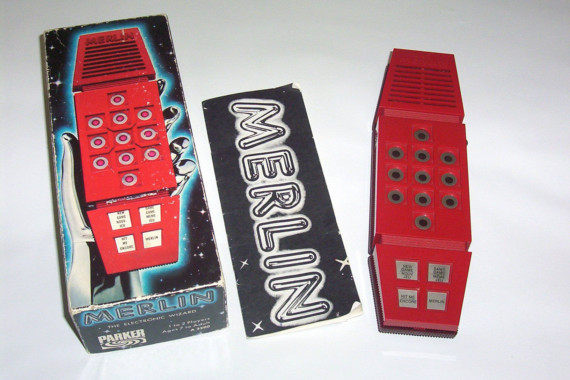
While searching the local re-use centre for electronic goodies a couple of weeks ago I spotted a cool retro-looking box with a hand-held game on the cover. In wonderful space-age chrome lettering on the side was the word 'Merlin.' "6 electronic games," the box proclaimed,  "vocabulary of space age sounds," "powerful computer brain." The game itself still resided inside, and though a little battered, it looked to be in working order. So for the princely sum of 25 cents it was mine.


I knew of this game, but had never played it. It was made by Parker Bros. in 1978 (a year before I was born). It's actually quite fun, but more importantly it makes some wonderfully retro bleep sounds. I've created a sample pack containing all these sounds, recorded direct from the speaker using my CAD GXL1200 through an ART USB preamp. The pack is hosted on freesound.org and is 100% royalty free.

One further note: although I made sure to use fresh batteries when making the recording, I realised afterward that Merlin is out-of-tune by approximately three semitones. Thus the tone 'do,' which should be a C, is closer to an A. This being the digital age, it can easily be corrected if you plan on using the sounds musically.

Tuesday, March 12, 2013

Studio Project: Slinky & Contact Mic

One of my current projects called for some experimentation with a miniature Slinky spring. For years it's been part of a lo-fi spring reverb that I built, which never worked very well (it needed a preamp). A friend of mine once told me he'd hooked a spring up to a contact microphone, and that's what gave me the idea to try it with the Slinky. So, a few minutes with some rubber bands, two microphone stands, some painter's tape, and a buffered contact microphone et voila:


I hooked it up to my ART USB dual preamp, but found better results with the Arctic MC6002 mixer. I filmed some short clips using both setups so you can hear the difference:


Sunday, March 10, 2013

Review: The Mechanicals

My e.p. 'The Mechanicals' has been reviewed by Mark Barton in Tales From The Attic Volume XI. His missive is a regular feature in the independent music and culture webzine God Is In The TV. Here's what he had to say about it:

Somewhere here after a casual rifling through cyberspace we happened across this little curio. A soundtrack no less for ‘the mechanicals’ story distributed by broken sea audio recorded and composed by the Manitou better known to kith and kin as British Columbia based musician Joshua M Blanc. Classic BBC Radiophonic Workshop fair is what you get for your time and due diligence albeit updated and eyed from a mid 90‘s Warp-esque minimalist craft, a perfect companion for those of you who managed to nab yourselves a copy of Ochre’s very excellent ’music from the tenth planet’ set from a few years back and I dare say that very excellent ’the séance at hobs lane’ outing from mount Vernon arts lab. Steeled in chilled atmospherics that creep with a tension seeped carnival-esque sense of the sinister, there’s a playful fondness for that old school hide behind the settee flavouring seeping out of these cosmic fairground sounds as though an Orbital c. ‘the box‘ and latter career Add N to X had been re-visioned by Raymond Scott whilst peeking through the eyes of the Barron‘s especially on the opening ‘the mechanicals – part 1‘. Etched in sparseness and couched in hymnal chorals ice chipped in detachment ’part 2’ is hollowed with the same analogue artistry as befitted the work of landscape whilst ’insufficient data’ is detailed with an ominously spectral wood folk chill factor that imagines Philippe Petit located in some servile mechanoid nightmare dosed up on a claustrophobic soundscape icily chimed to a meeting of Carpenter and Goldsmith minds. Creepily cool in short. http://themanitou.bandcamp.com/

Monday, March 4, 2013

Software Review: TAL U-NO-LX


Having a hands-on approach to sound design, it's not often I call upon VSTs (virtual instruments) to create sounds. I prefer VSTs that emulate instruments impractical (or impossible) to fit in my home studio: piano, orchestra, medieval instruments, etc.... To a lesser degree, I sometimes use emulations of classic synthesizers that are frightfully rare and/or expensive. But regardless of how good they might sound, the fact remains that the controls are on the computer screen and I don't enjoy working that way.

That isn't to say a sound can be created more quickly on a hardware synthesizer, especially if it's a complex one and the synthesizer offers a vast array of sound-shaping controls. But the process is more enjoyable to me if I can physically turn a knob or push a slider rather than fumble with a mouse pointer. When a hardware synthesizer is relatively simple, well laid-out, and easy to use, and it's virtual counterpart is all of these as well, then it's cause for celebration.

You may recall I rescued a Roland HS-60/Juno 106S from a thrift shop last year (see this post). It's since become one of my favourite synths thanks to its sound and ease of use. It's by no means perfect: it has some quirks due to its age and mis-use by its former owner. I can work around them, and so far it's behaved well for all the use its got. But, as with any piece of vintage hardware, I can foresee a time when it will need repairs that are beyond my skills to affect. Furthermore, it weighs as much as a small planet, so it's not what you'd call portable! This is where VSTs have an edge.

Enter: TAL software's U-NO-LX, an emulation of the Juno 60: the predecessor to the Juno 106. Not a lot changed between the two models. There are a few differences in the controls, but the basic architecture and sound are much the same. The biggest difference appears to be the loss of the arpeggiator in favour of MIDI control. I suspect Roland thought MIDI was such a big deal that they didn't spend much time 'improving' the layout and circuit-design (they saved that for the follow-up, the Alpha Juno - more about that in a future post).

In essence, you can craft many of the same sounds with both synthesizers, and theoretically, with the U-NO-LX software. I'll leave in-depth sound comparisons to those more qualified. Suffice to say, that the U-NO-LX sounds close enough to my 106 to make no difference. Instead, I'm going to focus on a couple of points I've not seen covered in other reviews of this VST.

The TAL website states: it's not possible to save presets in demo mode. This is the only limitation of the free version of the software, but it's also more limiting than you might imagine. You may think, as I did, that you'd be able to create your patches from scratch and the settings would be saved as part of the project in your DAW. Not so: upon reloading your song you'll find the U-NO-LX reset to the basic start-up patch. The free version is only useful if you directly record the audio output, or use it in a live setting. That said, you do get to experience the 'full monty' without any annoying time restrictions or bleeps - unless they're bleeps you've coaxed out of it yourself.

Secondly, for a fairly simple synthesizer, it does hog a lot of CPU. My system, an Intel dual-core 2.4ghz with 4gb of RAM and Windows XP, is perhaps not the optimum environment for VSTs in general, but it holds up capably with most. Two instances of U-NO-LX running at once is about the maximum my setup can handle. Sonar, my DAW, relies on DXI (direct-x) technology so I have to convert any native VSTi's using a program called Cakewalk VST Adapter. I'm not sure how much of the strain, if any, can be attributed to this.

Despite this issue, I think it's a well-designed VST, modelled with due attention to detail. You even get the Juno 60's arpeggiator, which can be synced to your project's tempo, if you wish - and I do! As of this writing, the full version is $40 USD. I found the process of paying for it trouble-free and had my activation code within seconds of the transfer. Considering that a Juno 106 sells for upwards of $600 these days, and a Juno 60 even more, I think that's an exceptional deal. I find programming it as easy and enjoyable as programming my HS-60 (well, maybe not quite!) and have the peace of mind that if ever my beloved hardware fails me, I won't be bereft of its distinctive sound.
Monday, January 28, 2013

The Mechanicals: Technical Commentary

Here's some technical commentary on the tracks from The Mechanicals e.p.:

The Mechanicals (Part 1)
Written to accompany a scene in a devastated spaceship. I started with the percussion: a hand-clap recorded in an old concrete loading bay (see this post) and a piece of 2.5" steel pipe being struck. The former was pitch-shifted an octave lower. Some minimal piano added bass to the track, and from there I added several layers of synthesizer. The bulk of the sounds were created on the Novation K-Station and feature two oscillators ring-modulated against each other. This is best illustrated by the deep bass sound with a wobble to it, and some of the sounds on the bridge section. The K-Station is also responsible for the white-noise percussion elements. A second bass sound, with a delay effect, was provided by the Arturia Minimoog V. The string sound with the rising attack and slow decay was made on the Roland HS-60, which seems well-suited to producing this kind of sound. The rest of the robotic and percussive sounds are sampled from a modified VTech Talking Whiz Kid, and modified PSS-140 keyboard. This kind of minimal electronic piece was something of a departure for me, and I'd like to write more in this vein.

The Mechanicals (Part 2)


I took an aborted bridge section from Part 1, built on it, and this is the result. I also wanted to illustrate the mechanicals concept lyrically. Since I didn't have to worry about clashing with dialogue, I filled up a lot more space in the mix. The Minimoog V makes a return, playing a different melody, and the K-Station provides most of the other synthesizer parts, including bass and lead sounds. The HS-60 adds a much subtler string sound: the best place to hear it is during the first break, accompanying the choir. EastWest Orchestra provides the choir, backing up three layers of my own voice saturated with reverb. My vocals on the verses are both raw and fed through the K-Station's vocoder. Singing backup is the AnalogX SayIt speech synthesizer, both untreated and fed through a granular plugin called Tweakbench Pudding. On the bridge section are several layers of my voice through the Roland SP-404's ring modulator effect. Modified Speak & Spell and Talking Whiz Kid samples can be heard as percussion and melodic elements throughout. As I wrote this 'on spec,' I was very pleased that parts of it were used in Stevie's Doctor Who production.

Insufficient Data
Written to accompany a scene in an abandoned technological structure on an alien planet. My initial concept was to base the track around humming electricity. To that end, I created a sound on the HS-60 not unlike the 60hz hum made by unshielded equipment plugged into 110volt mains voltage. Several attempts were made to find a suitable accompanying melody before the three-note piano motif and square-wave answering melody (courtesy of the K-Station) presented themselves. I intended to keep the track minimal, but during a percussion session in Fruity Loops I threw all sorts of rhythm elements into the mix that changed the whole feel of the track. These were mostly sourced from the modified Speak & Spell. A few Whiz Kid samples provide some eerie atmosphere on the intro, which I liken to the sounds of ages-old computers running forgotten programs for untold millenia. The timpani/kettle drum is from EastWest Orchestra, and the bass drum (with reverse reverb) is an old staple created on the K-Station. This ended up even more 'outside the box' than Mechanicals Part 1, and I'm very happy with it.

The Mechanicals (Part 2) [End Of The World Mix]


My friend Jimmy 'Jamz' Aaron sent me a rough remix of Mechanicals Part 2 he made by setting it to a new drum and rhythm track. This prompted a collaboration to produce it properly. I took out a lot of the original parts to give his heavier percussion more space. On the 21st of December (Apocalypse Day) I was inspired to add some entirely new synthesizer parts. The repeating melody that comes in under the verse was the first. It clashed somewhat with the original lead line, so I dropped the latter completely. In one of those serendipitous moments, a new lead presented itself and gelled immediately. Some resonant stabs from the HS-60 and some extra percussion elements from Jimmy's camp finished the track off. The entire remix was completed in four days, and both of us were thrilled with the result.

Monday, December 24, 2012

Digital E.P.: The Mechanicals

The trilogy of experimental robot music tracks I wrote for Doctor Who: Centurion is available on my bandcamp page. The track listing is as follows:

1. The Mechanicals (Part 1)
2. The Mechanicals (Part 2)
3. Insufficient Data
4. The Mechanicals (Part 2) [End Of The World Mix]

Running time: 21:03

The remix was a last-minute addition that my good friend Jimmy 'Jamz' Aaron and I cooked up over the Mayan Apocalypse (hence the title). It really took the track to another level.

Stay tuned for some track-by-track commentary.

Doctor Who: Centurion


I have some new music featured in Brokensea Audio Productions' latest audio episode of Doctor Who. You can download the episode for free here.

Two pieces were specifically written for scenes in the show. A third grew out of those sessions and was ultimately used, quite effectively I might add, to heighten the impact of key points of the story.

I've prepared an e.p. of these songs. Stay tuned for the details in a separate post.