2020 marked the 10th anniversary of Let’s Build Mecha! so it seemed like a good excuse to revisit it. I’ve always been happy with the sound quality, and I found the mix reasonable considering my lack of studio headphones or near-field monitors when I made it in 2010. At that time I was using a Logitech 5.1 system with a very clean – but thin – sound, and some Sony earbuds. It was also early days for mastering on my part. I believe I’d discovered the wavehammer compressor in Sound Forge by then, but none of the multi-tracks were summed to a master bus, and the title track was mixed-down with hard clipping instead of compression.
In 2012 I made some alterations – Clockwork Robots was made to run seamlessly into Autonomic, for example – but no real ‘remastering’ was done. The biggest hurdle, ten years later, was accessing the original multi-track files. They were recorded in Sonar 2 and 4 and saved as bundle files: single files containing all the data. Newer versions of Sonar don't play well with bundle files and prefer a project file pointing to a folder containing all the stems. A good comparison would be a zip file vs a folder. So I had to open the files on my old Windows XP machine, ensure all the samples and plug-ins were present, and export them.
A couple of songs needed no tinkering whatsoever, beyond clean mix-downs on a superior DAC and some mastering compression. Others required more care. The e.p. has always sounded clean and crisp to me, but I had to wonder why I'd chosen to EQ so many bass frequencies out. I’ll put it down to inexperience.
The songs that required the most attention were the title track - the most layered song on the album - and the other full vocal track: Production Line. The latter has always fallen a little flat, so I wanted to address that. Another challenging piece was Rust and Bones. The bass guitar always had a ground hum that stuck out like a sore thumb. Having some new tricks up my sleeve, I was able to address it. Another issue with that piece was the sampler I was using at the time, a clunky old horse called VSampler, which I could not resurrect. Each instance had to be replaced with Grace, my current sampler of choice, and the attack/release settings carefully tweaked by ear to match the original.
In most cases, the generic Cakewalk EQ plug-in was replaced with the superior Sonitus Equalizer. Heretofore unnoticed digital hiss on certain samples was carefully tamed. Vocals were brightened, and suppressed bass frequencies were restored. One tiny edit was made on the vocals of Production Line, where a slightly off-key word was replaced by an alternate take from the original session. The final step was to check the dynamic range of each track and adjust as necessary.
A little history. In 2010 my good friend Stevie K. Farnaby was producing a Doctor Who audio drama for Brokensea.org. He had an upcoming episode called Mechalution, which featured a race of sentient machines. He’d heard the music I’d been making with circuit-bent Speak and Spells, etc... and thought the sounds would be perfect for the show: both as music and sound effects. It just so happened that I had a song called Let’s Build Mecha, inspired by Japanese anime, and it fit the concept perfectly. With the script for Mechalution to hand, I set about writing the rest.
I don’t recall any difficulty or writer’s block. The subject matter was so in tune with my aesthetic that I could easily have carried on. In fact the Mechalution storyline was intended to carry on for the rest of the season, but for various reasons Stevie had to halt production. I wrote four more pieces for subsequent episodes (three of which can be found on The Mechanicals e.p.) and two more demos for what would've been the season finale. As of this writing, Stevie is upgrading his studio: so there’s a very real chance there’ll be more Mecha-inspired music forthcoming.
To coincide with the remaster, I've released a promo video for Production Line that was filmed in 2014 but never completed until now.
It's been almost two years, but I've finally completed a follow-up to Music of the Lake, my soundtrack to Sybille Muschik's ongoing Shoreline Studio series on YouTube. Originally it was to be "Music of the Lake II", but as the pieces aren't directly lake-related, it's named after the main suite on the album: The Floating Island.
Bandcamp player:
The artwork is a combination of photography and gell-plate art combined in Photoshop, and features the floating island itself. It might not be obvious that the photo was taken in the middle of the lake: in the winter of 2019, when the floating island became frozen there. The photo was taken on my first snow-shoeing pilgrimage to it with Sybille, when it was still intact. In very short order someone set fire to it and drove a snowmobile over it, and it became rather sorry looking.
When spring came, its journey continued and we lost track of it. We took several canoe trips in search of it, but never discovered its ultimate fate. It became such a point of interest to us that it made sense to write something musical about it for Sybille's show. I didn't realise just how monstrous an undertaking that would become...
As work progressed on Music of the Lake, my release from 2019, the songs shifted from short simple pieces to longer ones with more variation. Good examples would be Damselflies and the two Waterlily pieces. This was to avoid too much repetition when used for scoring: some of the Shoreline Studio episodes can run upwards of 40 minutes, and a thematic piece might be repeated several times throughout. So when it came time to create new music, I had two things in mind: to make the pieces longer and more dynamic, and to incorporate more of a world music flavour.
The Floating Island - official audio:
The Floating Island (suite) was the ultimate result of my efforts. It began simply as the first movement, and evolved into three more plus a reprise to tie things together. Some worldly instruments such as zither, udu, and log drums (all sounds from the Roland JV-2080 synthesizer) sit with the usual staples of bass guitar, analog and digital synthesizers, virtual piano & orchestra, and programmed drums. Electric and acoustic guitar also feature, as well as Behringer Model D for most of the lead parts. Field recordings from the lake and elsewhere were incorporated: including some ambiences from the lake in midwinter, and a massive thump made by the ice settling in spring.
Slide Zone - Not far from Bouchie Lake, in fact you have to drive over it to get there, is an area known as Knickerbocker hill, which used to be a rubbish dump and is now an active slide zone. The road surface is constantly shifting, and more and more of the supporting bank is disappearing into the river. If left to its own devices, the entire section of road will eventually disappear. This piece is about that.
Mining Relics - After the twenty-minute Floating Island suite was behind me, it wasn't my intention to write another piece that long. Then Sybille and I took a day trip to Wells, BC, to view and photograph a site where relics from the long-abandoned gold mine were unceremoniously dumped over the tailings pile (itself an imposing and interesting relic of the era). We spent perhaps three or four hours there all told, but I was inspired to write a piece of music that captured the essence of all I saw and felt there. So I set to work writing musical sketches, never quite putting my finger on the mood with any one piece. Thus it became another suite. As with The Floating Island, it was all compiled in a single multitrack project, which is a double-edged sword. On the one hand it allows you to have unifying elements across the entire project, on the other it becomes an organisational mess. Of the songs on this album, this was the most difficult to realise. Given the limited time on-site, I wasn't able to capture as many field recordings as I'd have liked, so I used what little I did gather and drew from my archive to provide metallic clangs and thumps. Style-wise, I drew heavily from Pink Floyd: for which I make no apologies. There ended up being a lot of electric guitar on this, and more Model D for the solos.
The Old Cabin (Golden Windows) - On the shore of Bouchie Lake sits a Victorian cabin. Around the time of the winter equinox, the setting sun illuminates the windows with golden light. I wrote this song about that, and my memory is that it came together quickly: almost as if channeled from somewhere. I chose instruments that reflect a sense of rural habitation, parlour dancing, and the ethereal nature of things left over from bygone days.
DT-RDX (top), Reface DX (bottom), my cat Pinot (top right).
About two years ago I acquired a second-hand Yamaha Reface DX four-operator FM synthesizer. I believe I've only used it on one song: it provides the main sequenced part on Blackbird Bend from Music of the Lake. I also use the very handy looper function for sketching ideas. As FM synthesizers go it's relatively easy to program your own sounds. But everything is done from one four-parameter touch-pad thingamajig and a series of push-buttons.
When the Korg OpSix was announced last year, a six-operator FM synth that promised even more user-friendly programmability, it went straight on my wish-list. Recently I got to try one in-store, and while I was able to get some interesting sounds out of it quickly, I wasn't impressed with the feel of the keyboard. I couldn't quite justify the price-tag, either.
So, as I already had the Reface DX and wasn't getting the most out of it, I looked into buying the DT-RDX MIDI programmer. DTronics' distributor Synthcity.nl is based in the Netherlands, and ordering from them was quick and simple. Synth and programmer combined still worked out cheaper than an OpSix, and to be honest, until I get used to how FM works, two fewer operators is probably a good thing.
Some minor gripes. Neither the DX or RTDX have very thorough manuals. Some infographics detailing the eccentricities of the envelopes, for example, would be handy. Another oddity is how the programmer attaches to the synth; ie. it slots loosely into the screw-holes underneath but doesn't actually screw in. For that you'd need to get hold of some longer screws with the correct thread. The other issue, with the DX itself, is patch storage, which is limited to 32. I can see myself filling that up in no time flat, and having to dump the sounds to hard-drive.
Aside from those few issues, having knob-per-function access to the programming parameters will make this a far more useful piece of kit.
Two years ago an amazing singer/songwriter from Cape Breton came to Wild Bill's Studio to record five original songs. Gary Hartley and myself recorded Meredith singing and playing guitar, and were then tasked with the job of putting a band behind her. Not an easy task, given that recording sessions usually start with the band and the vocals are saved till last. However, we were up to the challenge and the result is her debut album/EP: Waves.
Along with Gary on bass and some backing vocals, and myself on Fender Rhodes and synth, we drafted Grant Deachman for his precision drumming skills. There were multiple technical challenges, but all were overcome in time and we're all proud of the work we did, and proud to be a part of this amazing record.
The Fender Rhodes parts were demo'd for Meredith using a Yamaha Reface CP. For the final recording we used the real Fender Rhodes suitcase 73 that resides at Wild Bill's. I recorded the parts for all five songs in a day, having hardly ever touched the Rhodes up until that point. I was not prepared for how heavy the keyboard action is: my arm was sore for days! Having put in a lot more time on that instrument, I can now play it with relative ease.
Meredith Higgins' Waves is on all popular digital distribution and streaming services. You can listen for free on Spotify here.
A decade ago I said I would never buy a Korg M1. My reasoning was that it was digital (at the time I had the misguided view that digital synths were bad), and that Gary Numan overused the M1 presets on everything he recorded from approx. 1988 onwards (since it was released, in other words). I even passed up the opportunity to buy one for $300 around the time I said that.
I've since come to appreciate what digital synthesizers can bring to the table. Interestingly, so have a lot of other people, and the price of these machines has gone up in recent years. Despite that, I still paid just shy of $300 for this one. It needed a new internal battery and the presets reloaded, and has a few buttons that don't work, but other than that is in good condition. It was way cleaner inside than the DW8000 I had to restore recently, for instance.
So, what are my thoughts now that I own it? I still think it's an ugly machine, and I don't like the keyboard action very much. But overall the sound is decent, if dated. To my surprise, it has an on-board filter. It's more like a brilliance or brightness control (ie. not much depth to it, except in edit mode) but it's a mark in its favour. There are other things you can affect with the same slider control, too, such as the mix between the two digital wavetable oscillators of each sound. This makes it that little bit more endearing to someone like me who likes to create their own sound on a synthesizer, or at the very least change a preset enough that it has a unique flavour. A flip through the manual reveals that the designers expected the end user to program their own sounds with ease and relative quickness, but I wonder about that when there are so few controls on the front-panel.
At present I'm using it in my practice/writing space (along with the Reface DX). The piano sound is halfway decent, and there are other sounds that can inspire new ways of composing.
In the Rushes, from Music of the Lake. This video is only a year late (haha!). I've combined footage gathered over the last two years at Bouchie Lake, with studio footage and some mimed performance in front of my home-made green screen. Aside from some lighting issues, I think the latter turned out pretty good for a first go. This is one of my favourites from Music of the Lake, so I hope you like it.
It's my goal to publish at least one video per month this year, so I have my work cut out. If you like the song, the video, or both, please share it around on your social media of choice.
Out collecting video footage, winter 2020. (photo by Sybille Muschik).
I'm disappointed that I only wrote two blog posts in 2020, but given how busy the year was for me, both in and out of the studio, I can't say I'm surprised. A lot of things I spoke about in the 2019: Year In Review post that I hoped to accomplish in 2020 simply didn't happen.
The year started off with a commission from Johnny Who Entertainments, an independent film company in the UK. I was asked to remake the theme from the 1978 BBC TV show Blake's 7, originally composed for orchestra by Dudley Simpson. It turned into one of the most complicated and multi-layered pieces of music I've ever worked on. My goal was to pay homage to the aesthetic of the original, and improve upon it with some modern touches. In this regard I succeeded, but I just about burned out. I have fond memories of watching the series when I was a kid. As yet, the theme is unreleased.
In March, after much rehearsal, I accompanied my band No More Cries to Vancouver to play at the Roxy Cabaret. This was right at the beginning of the Covid scare, and the show was cancelled the night we made it to the city. So I spent a couple of days wandering the downtown area as anti-pandemic measures were rolled out. It was a surreal experience.
First signs of the end-times, Vancouver, March.
One high-point of the Vancouver trip was getting to see a Moog One with my own eyes at Tom Lee Music, and lo, even try it out. But $10,000 CDN is far beyond my budget, so I came home with a far more sensible Behringer Model D. We also looked at some incredible grand pianos in their showroom, one of which was in the region of $70,000.
A Moog One in all it's glory (and a Subsequent 37 above it).
It was while in Vancouver that I lost contact with my good friend and collaborator JLA, the other half of Disco Antenna. We'd conspired to release the Disco Antenna album 'Disco From The Stars' last year, but for various reasons that never happened. He did, however, give his blessing on the final mixes and artwork, as well as the DFTS video that's waiting in the wings. I miss you, J...
UPDATE: JLA is alive and well! We'll discuss a release date for DFTS in due course.
Throughout the year I composed new music for Sybille Muschik's Shoreline Studio YouTube series (now 20+ episodes strong). As of this post, 55 minutes' worth of music is nearing completion. I'd planned to release it as 'Music of the Lake II', but since only one of the four pieces is to do with the lake specifically, it'll be called 'The Floating Island' instead. Stay tuned for that very soon.
The floating island (photo taken from roughly the middle of the frozen lake).
In October, No More Cries filmed a music video against a giant home-made green screen. It's currently in post-production.
Doing my best to look like I'm in a rock video.
My album, 'Dreams of Sleeping Engines', still hasn't seen the light of day, beyond some physical copies that got handed around in 2020. I need the time to concentrate on promotional videos before I release it digitally. To that end, I've made my own green-screen at home.
August 2020 marked the 10th anniversary of my e.p. 'Let's Build Mecha'. For some time I've wanted to remaster it, and put together the video I filmed (but never edited) for 'Production Line'. So this seemed a good excuse. The remastering part is done, and I'm very happy with it, but the film is still in mothballs. This year for sure (haha!).
Meredith Higgins' five-song CD, 'Waves', which we produced at Wild Bill's Studio, saw a physical release at Christmas. It's set to be released
digitally very soon, so watch this space.
Recording sessions for Danny Brickell's second album were also completed late last year, and it's currently at the mixing stage.
What else is new? I now have an instagram account, where I'll post occasional images related to my work.
Like them or loathe them, Behringer are making waves recreating synthesizers from the past so that people such as myself, who missed owning the originals, can own brand new iterations of rare classics. The Model D, for the uninitiated, is based on the Moog Minimoog Model D - quite possibly the most famous synthesizer ever made. Most of the musicians who have influenced me used a Minimoog at some time or other. It's appeared on more classic records than you can shake a stick at. So it's no exaggeration to say I've coveted one all my life. The Behringer version promises the same circuit design with some new twists (note the CV input jacks along the top of the unit) at an affordable price. Not having access to an original Minimoog, I can't comment on the authenticity of the sound; suffice to say that it sounds very close to me, and that's what matters.
One of the first things I noticed is that the tuning drifts and is not especially stable. This is what's called a feature, for you can't have the original Minimoog circuitry without the original foibles. The tuning knob provides four semitones of wiggle room. I'm using it strictly in the studio, so tuning it between takes and letting it warm up is not a huge deal to me. It might be an issue in a live setting.
I've owned software emulations of the Minimoog, but never fully understood the architecture until I was able to spend a half hour in front of the hardware. It's all starting to make sense to me now, and it hasn't taken long for certain controls and functions to become second nature.
One thing I still find difficult to get to grips with is what they call legato. In this case, when you play two (or more) notes in a row without lifting your fingers, the amplitude envelope doesn't retrigger. Instead, the first note sounds strong, but the second and subsequent notes sound weak: depending on how your envelope is set. Arturia and Moog's software emulations had a switch to overcome this, but apparently the Behringer D does not. So one has to play the notes with more care in order to retrigger the envelope. That said, the legato nature of the notes can be a desirable effect. The MS-20 also does this, but not as extreme as the Model D.
I'll have to spend some time with the emulations to discover what else is different, control-wise. The CV (Control Voltage) jacks along the top give you patch-points for plugging into modular synths or routing certain functions back to the unit (LFO to filter cutoff, for example). There's also a 440Hz test-tone available at the flip of a switch - handy for tuning - and three separate outputs: line out (1/4"), headphones (1/8"), and main (1/8"). The latter can be routed to Ext-in for the famous Moog overdrive sound.
You'll be hearing this a lot in coming productions. It already features on the first new piece for Music of the Lake II.
The picture above doesn't necessarily represent 2019, but you could say that work in the studio was somewhat chaotic. If you look back at my 'year in review' for 2018, you'll note I made some statements about my release schedule that didn't exactly fall into place. The Atmospheres album did eventually see the light of day, but very late in the year because of a busy spring and summer. My magnum opus Dreams of Sleeping Engines is still not out, but on the plus side I took extra time to fix some things I wasn't happy with.
A list of my audio-visual related accomplishments for 2019:
-Collaborated with Disco Antenna on a cover of Bronski Beat's 'Smalltown Boy'.
-Mixed and mastered the 'Seven' EP for No More Cries (on which I also play keyboards and sing backup).
-Filmed a music video for No More Cries (still in post-production).
-Recorded Fender Rhodes and synthesizer for Meredith Higgins' debut EP 'Waves', release date TBA.
-Debuted The Manitou's 2014 album 'Radioatomic' on major download and streaming sites via DistroKid.
-Released The Manitou's album 'Atmospheres' via Bandcamp and DistroKid.
-Composed 11 songs for Sybille Muschik's Shoreline Studio Video Blog, subsequently released as an album titled 'Music of the Lake'. Filmed and edited 7 videos for Sybille's channel.
-Completed work on The Manitou's 'Dreams of Sleeping Engines', release date TBA.
What are my goals for 2020? Certainly to release the things that didn't make it into last year's roster; promote my music better; write a follow-up to Music of the Lake and continue with the filming work for Sybille's show; revisit some material from a 'lost' Manitou album from 2010; start work on some Audio Drama soundtracks I've been asked to compose; remaster portions of my back-catalog for DistroKid release; finish the No More Cries music video (and perhaps film another one). That would be a good start!
In April of 2019 I was asked to collaborate on a video blog project with local artist Sybille Muschik. In addition to filming and editing, I was asked to write original music for the series. The initial brief was that it should be upbeat and interesting: nothing that would put people to sleep. As I spent more time at Sybille's lake-shore home, the lake itself became a focus of the music. Over a period of months, sounds that evoke water, and field recordings from the lake itself (and other bodies of water), were woven into instrumental songs that referenced aspects or experiences of the lake and surrounding watershed.
In the few weeks after our initial meeting I created a series of short musical sketches. These consisted of basic drum patterns, chord progressions on virtual Rhodes electric piano or synthesizer, synth or piano melodies, and bass guitar parts. I chose fifteen to present to Sybille, who then whittled them down to eight, including one that would become the theme song. I rejected a further two, finding them uninspiring in the end! Perhaps I'll share some of these sketches in the future.
After developing the initial six songs, I had a clearer idea of Sybille's tastes and the direction the music should go. I presented the remainder of the songs as finished pieces.
We never discussed how many songs there should be, but I tend to think in terms of albums (or EP's at the very least), and inspiration led me to eleven. Each one pushed me creatively in many ways. I played bass guitar on all but one track (the most I've ever used on an album). I strove to make sampled drum machines sound more like real drums: both sonically and in the way that they're programmed. I made synths sound like guitars, and played real guitar when it was within my abilities. I scoured my backlog of field recordings for water and nature sounds and collected more in the field. I even made an orchestral song without an orchestra! But perhaps the biggest challenge was to work in different styles and moods than I have before.
This is my first paying soundtrack job. The entire process has been fun and exciting. There's scope for a 'volume two' after a well-deserved break. The lake continues to inspire through the changing seasons and as my knowledge of its biodiversity expands. Bandcamp Player:
Track by track commentary: 1. Sunbursts (Shoreline Theme)
Out of four sketches with potential for theme songs, this was the most energetic. The working title was simply 'theme 3, piano'. The twinkly arpeggio suggested the bright sunbursts reflecting off water on a sunny day. The short version of the theme is essentially what I would call the chorus. Coming up with a 'verse' to accompany it was a challenge.
2. Pond Skaters
This changed considerably from my sketch. The signature bubbly bell sound is based on a preset from a virtual synth called Firebird. There is a random element to the patch, which means it sounds different every time the song plays live in my workstation or is rendered as a mixdown. In order to even come close to how a pivotal mixdown sounded, I had to 'print' multiple takes of the Firebird parts and choose the best passages. The title was inspired by a large swarm of whirligig beetles skating on the water.
Video:
3. Blackbird Bend
In March, before I even started on this project, I spent an hour on a frosty morning in a wooded area by the lake, capturing the dawn chorus with my Tascam digital recorder. The principle songbirds I sought were the red-winged blackbirds. A snippet of that recording is the ambient backdrop for this song.
4. In the Rushes
This is the first song I came with up on my own initiative, as it were, having completed the first six Sybille had chosen from my sketches. After hearing Pan's Blessing she expressed a wish that there was more variation to the melody. Rather than rework that song, I wrote this instead. It's also the first piece written with a facet of the lake in mind: the rushes that grow along the shoreline, the water that laps between their stalks, the sound they make in the wind, and the insects and marine-life that live among them.
5. Spawning Beds
I was privileged to see (and film) trout spawning in the creek that runs out of the lake. This song is inspired by them, and the erratic way they swim in the fast-moving water above the weir. It was Sybille's idea to include a recording of the creek itself.
6. Surface Patterns
Since embarking on this project I couldn't help but write a laid-back piece evoking the swirling and undulating nature of water and the varied and mesmerizing patternson the water's surface.
7. Pan's Blessing
As it was spring when I started Music of the Lake, I took inspiration from the process of thawing, the return of plant and animal-life to the area, and the warm feeling of celebration it brings. The pan pipe sound was a last-minute addition inspired by the title.
8. Water Lilies (Yellow)
As the soundtrack was nearing completion, Sybille requested I write a piece about the water lilies found in the lake, of which there are two species. We went canoeing to photograph them (the yellow variety graces the album cover), and to check on their health. The yellow water lily is endemic to the lake, and in danger of being choked out by the white (or 'fragrant'), which is introduced.I chose an ethnic instrument akin to a kalimba, some soft Rhodes piano, and mellow synthesizer to represent the yellow species and its vulnerability. 9. Water Lilies (White)
For the white water lily, I chose a bolder palette: harps that evoke an air of royalty, strings that suggest the conquest of the lake by spreading leaves and rhizomes, and isolated twinkles from the synthesizer to represent white blooms breaking through the carpet of green. The chime tree that accompanies both water lily pieces represents motion, in this case the gentle undulation of lily pads upon the water.
10. Damselflies
At the peak of their hatching, you may see hundreds of brilliant blue damselflies hovering at lake's edge. This song is for them and their larger dragonfly cousins. If you detect a similarity in sound and style to 'In the Rushes' it's because both songs were made in tandem. With my Rhodes emulation running through a delay effect, several layers of rhythm and melody were built up to form the backbone of both songs.
11. Paddling
Sybille liked the idea of an orchestral piece, so I put my mind to it. Nothing came to me for about a week, and then I wrote and orchestrated this in about three hours flat (though it took longer to finesse and add finishing touches). The sounds of canoeing and loon calls were recorded on a camping trip with my band-mate, Gary Hartley.
Music of the Lake is available on bandcamp and all major digital distributors except G**gle.
Video - Shoreline Studio Video Blog Episode 1A:
You can check out the rest of Sybille Muschik's Shoreline Studio Video Blog here, and find out more about her work at www.sybillemuschik.com.
This release has been waiting in the wings since Christmas 2018. I've been busy with various things in the interim, but several events have brought it to the front of my mind, such as the anniversary of the day that inspired 'The Ash Monk': August 17th. More about that in the commentary below.
Ever since I started composing soundtracks, pieces would emerge that are more atmosphere than music. One of my goals has been to create an original album of them. In December of 2015 I released the first handful as an EP (see this post), which have been remastered for the full album.
My ideal was to create dark, moody, and somewhat unobtrusive sound collages that could be played in the background while doing other creative things: much like Brian Eno's masterful 'Ambient 2: On Land'. To say I succeeded in matching the greatness of that album would be a stretch, but most of the tracks lived up to my expectations.
When it came time to master this album, I wanted to record it to 1/4" reel-to-reel tape. Some of the field recordings had background hiss, and my thought was to mask that with the hiss of analog tape. I even went so far as to record a version on my Fostex X26 four-track. The resulting tape sounded fantastic, but re-digitizing it revealed a flaw in my thinking: to get the levels back up to digital standards, the hiss became too obtrusive.
In the end I chose to stay within the digital realm. I spent some extra time carefully taming hiss with EQ's, and auditioned several (free) tape saturation plugins: settling on one called Ferrous. The album sounded good before the Ferrous treatment, but now it sounds great. I decided to sequence the album as a continuous mix, rather than individual tracks with breaks inbetween.
Bandcamp Player:
Here is my usual track-by-track rundown:
1. The Hungry Grass
The
bell-like and largely dissonant melody that forms the backbone of ‘The Hungry
Grass’ was created by a device called a MIDI Sprout: reading micro-voltages
from the leaf of a peace lily that lives in my studio, converting them to MIDI
notes and feeding them to an emulation of a Fender Rhodes electric piano, while
I worked the sustain pedal. This was captured on cassette tape and played back
at half speed. Various field-recordings were similarly pitch-shifted and run
through effects over top, and once I’d decided on a title, I rustled a bunch of
dried leaves in front of a microphone to simulate the reaching fronds of
‘hungry grass’: a botanical menace from Irish folklore, wont to waylay
travellers and spirit them away to the land of the fey.
In 2010 I
was fortunate to visit a correspondent of mine, Jay Ellington Lee, at his home
in the outskirts of Tucson,
Arizona. Sadly, Jay passed away
the following year. Among other things he was a composer for film, radio, and
television; had a hand in designing the E-Mu Modular synthesizer, and was an
all-round creative boffin. I shall forever be grateful for his friendship, and
the opportunity to visit the Sonora
Desert. This soundscape
is based on recordings I made at his home, and is an attempt to capture my
impressions of the desert, which is more alive than one might first imagine.
One evening Jay dug out some LED light boxes, and we both ventured into the
night to light and photograph cacti. I was pleased with the eerie and surreal
results. I had those photographs in mind when I set about recording.
3. Down in the Data Mines -
'Data mining' seems to be the gold rush of the new millenium, with companies
like G**gle and FaceB**k collecting and storing data left, right, and centre.
‘Down in the Data Mines’ looks at the concept from the point of view of the
virtual robots whizzing around the ethernet and doing the actual 'digging'. A
lot of sounds from circuit-bent electronics, and a recording of a particularly noisy
fridge, feature on this one.
When I read
an article about a mystery sound – something like a sonar ping – heard in, yes,
Fury Strait, I couldn’t help but be inspired by it. I put my mind to what it
might sound like, choosing the Novation K-Station to realise it, and tweaking parameters
until it sounded suitably eerie. This was set to the treated sound of waves
recorded at Foul Bay
(Victoria, BC), and some plaintive simulated guitars –
chosen because someone was playing a guitar that day on the beach when I made
my recording.
Another
title inspired by an article. The ‘Towers of Silence’ exist, but they aren’t
perhaps what you might expect them to be. My fanciful imagination pictured vast
towering structures that broadcast ‘silence’ in the form of noise-cancelling
transmissions, hence my choice of washes of white noise – captured from a car
wash in Abbortsford, BC – over richly varied sounds from the greensward beside
an MDF plant.
Instruments: Firebird VST, Sampler (MDF plant + woodland ambience, well casing, piledriver, car wash).
6. The Ash Monk
You may
have read about, or even experienced, the wildfires that plagued British Columbia for two
consecutive summers. The Ash Monk was written during the second wave, having
seen red-tinged darkness at two-o’clock in the afternoon and air that you wouldn’t
breathe if you had a choice. In an attempt to capture some of that feeling of
apocalyptic dread, I called upon the MIDI Sprout: this time sequencing an FM
chime sound. Perhaps perversely, I paired the treated result with a
pitch-shifted recording of water dripping onto an upturned bath. It surprised
me that the drips had a considerable echo when they were slowed down, so I
emphasized this effect. My own feelings were added in the form of a very simple
but dread-laden improvisation on emulated Rhodes.
The title is drawn from Japanese folklore.
A
synthesizer sequence made with MS-20 Mini and SQ-1 sequencer, rejected from an
early version of 'Cacti', became the basis for this track. The concept of
landwhales came from a comic by Akira Toriyama. Perhaps this is what you might
hear as these vast creatures lumber across the continent.
A restless
night in an old asphalt testing lab in the industrial zone, marked by the sound
of an incessant clock, massive central heating, the constant hum of a server
farm, and waking dreams, was the inspiration. Recordings from the actual
location were used, along with some stand-ins and a few tape experiments to
exaggerate the experience.
Instruments: Korg MS20 Mini (pink noise), Spring Thing mk3, Boss RE-20 Space Echo, Sampler (wind-up alarm clock, wall clock, server room, gas furnace, road paving machine, heating clunks).
Video:
9. Those Who Haunt the Workhouse
An idling
diesel locomotive and some industrial noises, all heavily treated, paint this
picture of lingering souls who lost their lives in industrial accidents of
times passed.
Instruments: Korg MS20 Mini, TAL U-No-LX VST, Sampler (diesel locomotives, loading bay, voices, door squeak).
10. Well of Souls
The bulk of
this soundscape consists of remarkable sounds made by a faulty toilet flusher
valve. It also features an out-of-tune piano a kind lady by the name of Cleo
allowed me to sample (her wheezing dog also makes an appearance on 'Landwhales').
I'm a little late in posting anything about the JV-2080, which I bought a couple of years ago. This is by no means an in-depth review, as I'm never likely to tap into its full potential. I'm not interested in programming it, for instance, as it requires a lot of menu-diving, pressing of buttons, and scrolling with a single encoder knob. For that matter, the kind of sounds I like to make are best made on analog machines. So why do I have this? Quite simply, for immediate access to (fairly) realistic sounds of real-world instruments.
I'm not very good on acoustic guitar, for example, and if I want a nice mellow arpeggiated guitar part for a track, it's obtainable with the JV-2080. It's never going to sound as good as a real acoustic guitar, of course, but as an embellishment for an otherwise electronic track it works very well.
Another example. A recent project required a vibraphone. Now, a vibraphone is a gigantic instrument that I'd never be able to get into the studio, even if I could find one locally. The JV-2080 has an authentic-sounding vibraphone, and all it needed was some vibrato from one of the on-board LFOs to make it sound like the motor was engaged. Small edits of a sound, such as the aforementioned vibrato, or longer/shorter decay are easily accomplished, and on-board effects can be turned on or off via the front panel.
There are an insane amount of sounds on-board (640 presets, 128 user) that cover the basics and even a few instruments you might not think of. There's even a banjo, though it fails to come close to a real one.
I recently wrote an orchestral piece (albeit fake orchestra), and found myself wishing I had a wider range of orchestral sounds in my arsenal. With that in mind, I hunted around online for the Orchestral expansion card: one of many made for this and other Roland units. There are eight slots under the removable panel on top of the unit for these cards. Mine actually has stickers for the Orchestral and Special FX expansions on top, but they were taken out at some point and likely sold individually or kept by a previous owner.
In my online researches, I discovered that Roland issued a 'cease usage'
warning for all SR-JV80 expansion cards in 2017, because the
electrolyte from the 20 year-old capacitor mounted to each board has a
tendency to leak, leading to smoke, fire, and in worst-case scenarios,
explosions! What to do? Thankfully replacing the capacitor with a new
one is not difficult if you're patient and competent with a soldering iron. Refurbishing two expansion boards took
me about 45 minutes. Thanks must go to Don Solaris for his instruction video on how to do this. My JV-2080 is now fitted with the freshly refurbished Orchestral and World expansion boards.
Expansion boards after refurbishment. Note the old capacitors in the foreground.
Since SR-JV80 expansion cards aren't easy to find in brand new condition these days, the two I ordered were both missing the original boxes. I wasn't sure what I needed in order to mount them (screws, for instance). Thankfully, fitting them is straightforward: once you unscrew the panel, you just press the cards into place. Each card fits into a data-port type slot, and is held by three plastic pegs sticking out of the JV-2080's innards.
Orchestral and World boards snug in their new home.
Back in February of 2018 I wrote this post about a new-old addition to the studio, a poorly Korg DW-8000. I got a good deal on it, but it was in need of some work; to whit: the internal battery needed replacing, some of the buttons weren't very responsive, the keyboard 'action' was quite horrible (and felt like it was bunged up with grit), and the synth was generally filthy. Indeed, since purchasing it, I refrained from programming any sounds because of the battery issue and sticky buttons that turned saving patches into Russian Roulette.
Today, I'm pleased to announce that all the issues listed above have been addressed, to the best of my abilities. There wasn't a lot I could do to improve the key-bed, but I've at least cleaned and re-felted it.
First I opened it up. Several screws (and two rubber feet) are missing from the bottom of my DW-8000 so there aren't as many screws to remove as there ought to be! I found it helpful to draw a map of where they go. I didn't do this with the internal screws, although I probably should have: instead opting to keep them grouped in separate containers.
It soon became apparent that to effect all my repairs I'd have to completely separate the two halves of the synth. This required unplugging approx. ten connectors connecting the lower circuit-boards to the upper, and unscrewing the power button/connector mount. The circuit-board with the backup battery attached was then completely removed so I could de-solder the old battery and fit a battery holder. If I'd given it more thought, I'd have extended the leads of the battery holder so that I could hot-glue it to the chassis. I made do with zip-tying it to one of the wire bundles.
The bottom-half, separated. The board with the battery is the center one.
Replacement battery holder (photo taken after reassembly).
Next I tackled the buttons or 'tact switches'. To get to these I had to remove all the circuit boards and key-bed from the upper half of the synth (being careful to use an anti-static bag where necessary, and wear a grounding strap). The task was a little daunting, to say the least, but it also allowed me to give the plastic casing of the synth a proper clean. I started with undiluted Mr. Clean on a damp cloth, and was not surprised to see it remove copious amounts of brown tobacco residue. The casing was then rinsed thoroughly outdoors (inside and out) with the garden sprayer to remove cleaner residue and dust from crevices.
Outer casing after cleaning.
Now having access to the switches, I could go about cleaning them. I wasn't game to remove the proprietary caps, and thankfully it wasn't necessary. If you're gentle with the pressure, you can carefully drip DeOxit D5 into the hairline gap where the two moving parts of the switch meet. The trick is then to work the switch a bunch of times, and drip a little more as you go. Don't be afraid if it dribbles onto the circuit-board. It took a few passes to completely swab it away when I was done, and I turned the boards upside down for a while to let any excess drip away. As an added bonus, the excess liquid helped remove more tobacco residue from the circuit boards. The four sliders were also treated, with DeOxit FaderLube.
The innards removed, tact-switches exposed.
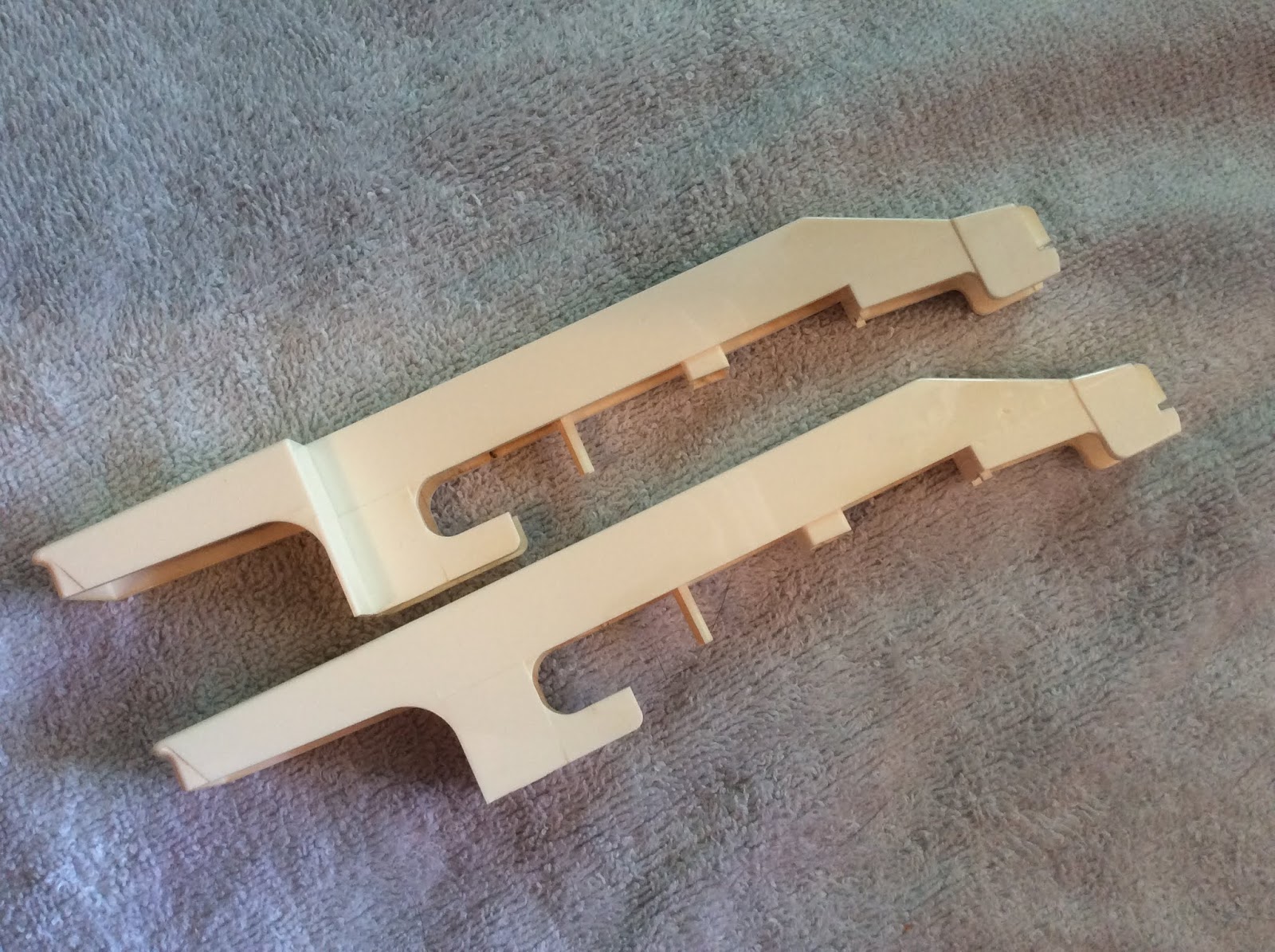
Next I worked on the key-bed. Every key was removed from the frame. I found it easiest to turn it upside down for this step, removing white keys first, then black. If you wiggle a small flat-head screwdriver between the prongs where the key hinges while pulling the key towards you it will loosen its grip and the key will drop out (oftentimes a little push on the clamping part helps it along). This way the little spring clip that holds the key in place drops into the body of the key when you remove it, making it easy to retrieve. The clamping prongs have long been broken on three of the keys, and there's not much I can do about that beyond replacing the keys altogether. Perhaps another time. They still work but are just a little wonky. I somehow managed to snap one of the struts that presses down on the key contacts while removing one key, and repaired it with epoxy and a piece of paperclip for reinforcement. It amazes me that a part so integral to the working of the keyboard is relatively thin and easily breakable, compared to the rest of the key.
Removing the keys.
Keys removed.
Each key was individually washed, in a solution of Mr. Clean and hot water, then rinsed in plain hot water and dried. This took about an hour, but was worth it. The keys were absolutely filthy: the sides felt like sticky sandpaper.
Brown!
After cleaning.
The metal frame was similarly grubby. Dirt, detritus, the ubiquitous tobacco goo, and quite a bit of rust was caked on it. I also gave it a wipe down and hit it with a bit of compressed air.
The initial state of the keyboard frame. The brown lines correspond to gaps in the keys.
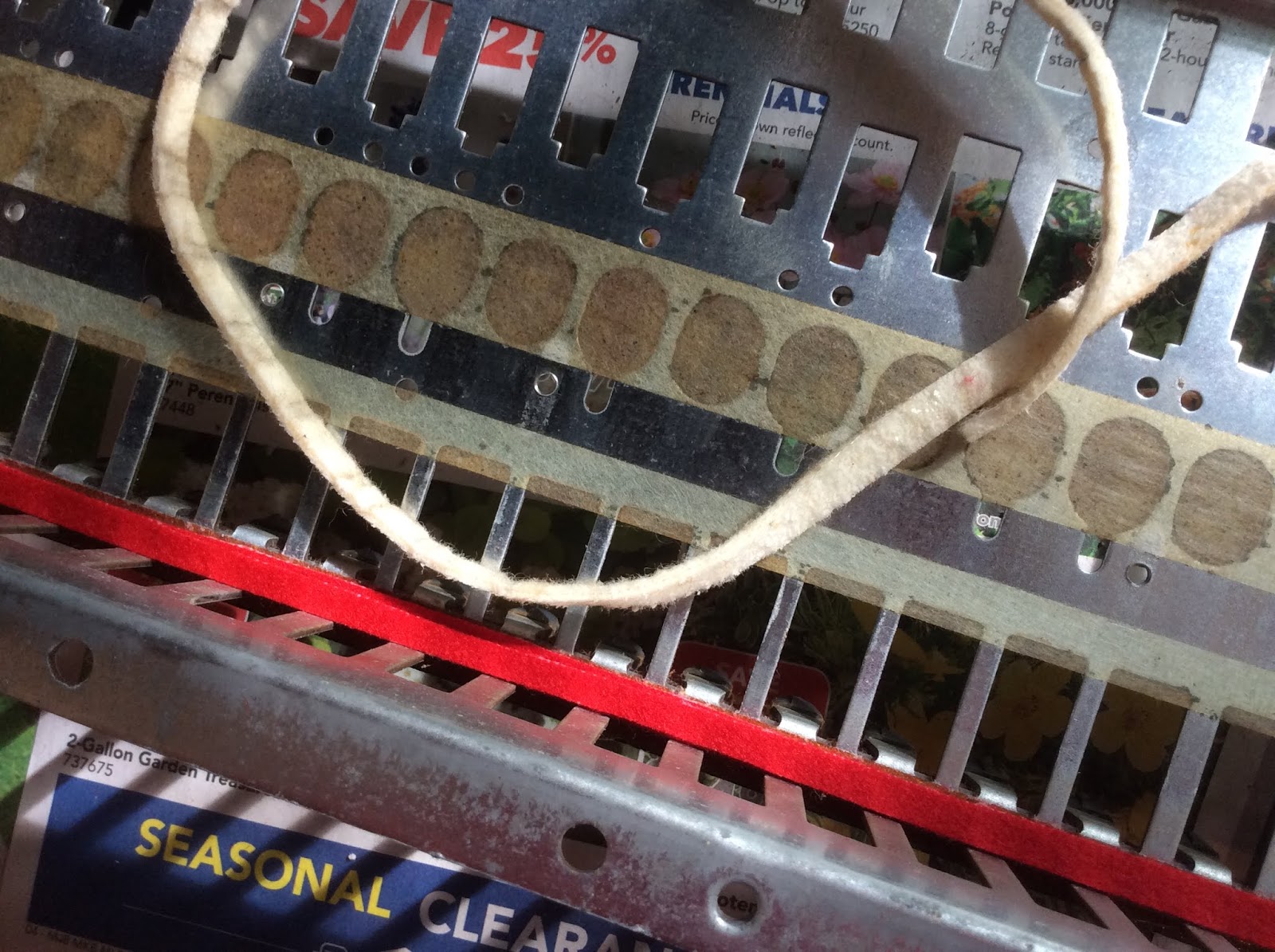
Before reassembly, I replaced the action felt underneath the key-bed. I was keen to replace the top layer, too, but as there's a conductive strip underneath for controlling aftertouch, as well as a layer of some sort of rubber, I left it as-is. The felt I ordered turned out to be half the thickness of the original, so I cut it in half and doubled it. The action is still not amazing, but just having clean keys makes it so much nicer.
New felt.
New felt vs. old felt.
I addressed the cigarette burns in the two very top keys (see the previous DW-8000 post) by carefully shaving the lumps down with a Stanley knife and hitting them with a bit of fine-grit sandpaper (masking off with tape first). They're not 100%, but most of the deformation and discoloration is gone and they're much nicer to look at.
Treated cigarette burn.
Each key contact has a little rubber pad that the key presses down on. These were covered in gunk, but as their function is mechanical rather than electrical, it wasn't necessary to clean them. In the interest of being thorough, I gave them a swab with some distilled water. I cleaned the rest of the contact assembly circuit-board while I was at it, at least to get the worst of the gunk off.
Key contact assembly: note gunk on black rubber pads and black specks on circuit board.
Not perfect, but here's how it came up after swabbing.
Last but not least, it was time to put everything back together. The key-bed was reassembled in reverse order: black keys first, then white; aftertouch board reattached, all circuit-boards re-housed in casing, key-bed re-seated, and finally the connectors plugged back into the lower half of the keyboard, battery installed, and everything screwed back together.
Circuit-boards going back in.
Key-bed reassembly.
Reinstalling the key clips. I recommend wearing gloves to spare your fingers!
Key-bed reassembled.
Ready to reattach connectors. Note the labels so I could get them back in the right spot!
With everything back together, came the moment of truth. Does it still work? Were my improvements a success? Thankfully, yes on both counts. It powered on with no issues. Without the presets loaded into memory, it made a pitch drop sound upon pressing a key. I sampled this sound on middle C, C2 and C1 for posterity. I'll be providing free downloads via freesound.org in a future edit of this post.
The Korg DW-8000 is equipped with MIDI, but I was unable to find the Bank A factory presets in sysex format anywhere on the web. However, an audio file in machine language can be found here, and was successfully loaded via the tape data input.
I'll leave you with this short video: factory program number 77 proving a successful re-loading of the factory presets and fully functioning unit!
JLA presented me with a backing track and lead vocals for this Hi-NRG version of a classic club track from 1984, originally by the UK band Bronski Beat. I've often thought JLA could do a great job of matching Jimmy Somerville's unique voice, and he doesn't disappoint. I worked some production magic on it, adding backing vocals, synths, strings, and bass guitar. We both feel we've not only done the original proud but put a unique spin on it into the bargain. We hope you enjoy the free download.